The Future Trends of AI in Business Automation: Forecasts to 2030 and Opportunities for Enterprises
From simple Robotic Process Automation (RPA) to autonomous AI (agentic AI), business automation is entering an explosive phase driven by the convergence of next-generation artificial intelligence (GenAI) and hyperautomation. According to McKinsey and Forbes, by 2030, more than 70% of enterprises will adopt AI agents to automate not only repetitive processes but also complex decision-making tasks.
In Vietnam, with rapid digital transformation and the strong growth of e-commerce, this represents a major opportunity for small businesses—such as online stores on store.bbotech.vn—to take the lead by adopting these trends early. This article explores the key trends, real-world impacts, and how businesses can prepare to avoid being left behind.
The Evolution of AI in Business Automation
Business automation has evolved through several stages:
– RPA (2010s): Rule-based automation (clicking, copying, pasting).
– Intelligent Automation (2020s): Combining RPA with AI/ML to process unstructured data.
– Agentic AI & Hyperautomation (2025–2030): Autonomous AI agents that can make decisions, learn independently, and orchestrate multiple tools without continuous human intervention.
Key Future Trends
1. Agentic AI – Autonomous AI replacing complex work: No longer limited to answering questions, AI agents will plan and execute multi-step tasks autonomously (e.g., analyzing sales data → proposing marketing campaigns → deploying and measuring results). According to UiPath and Gartner, agentic AI is expected to dominate the automation market by 2026–2027.
2. Hyperautomation – End-to-end automation: The integration of RPA, AI, ML, GenAI, and low-code platforms to automate entire value chains. InRule and Blue Prism forecast that hyperautomation can reduce operating costs by 40–60% and increase processing speed by up to 10x.
3. Human–AI Collaboration: AI will not fully replace humans but will significantly augment human productivity. Employees will focus on creativity and strategy, while AI handles the rest (Aspen University & WEF).
4. Ethical governance and AI management: With higher autonomy, businesses must adopt “governance-as-code” to ensure AI transparency, security, and legal compliance (including data protection regulations such as Vietnam’s PDPA).
5. Practical applications in e-commerce:
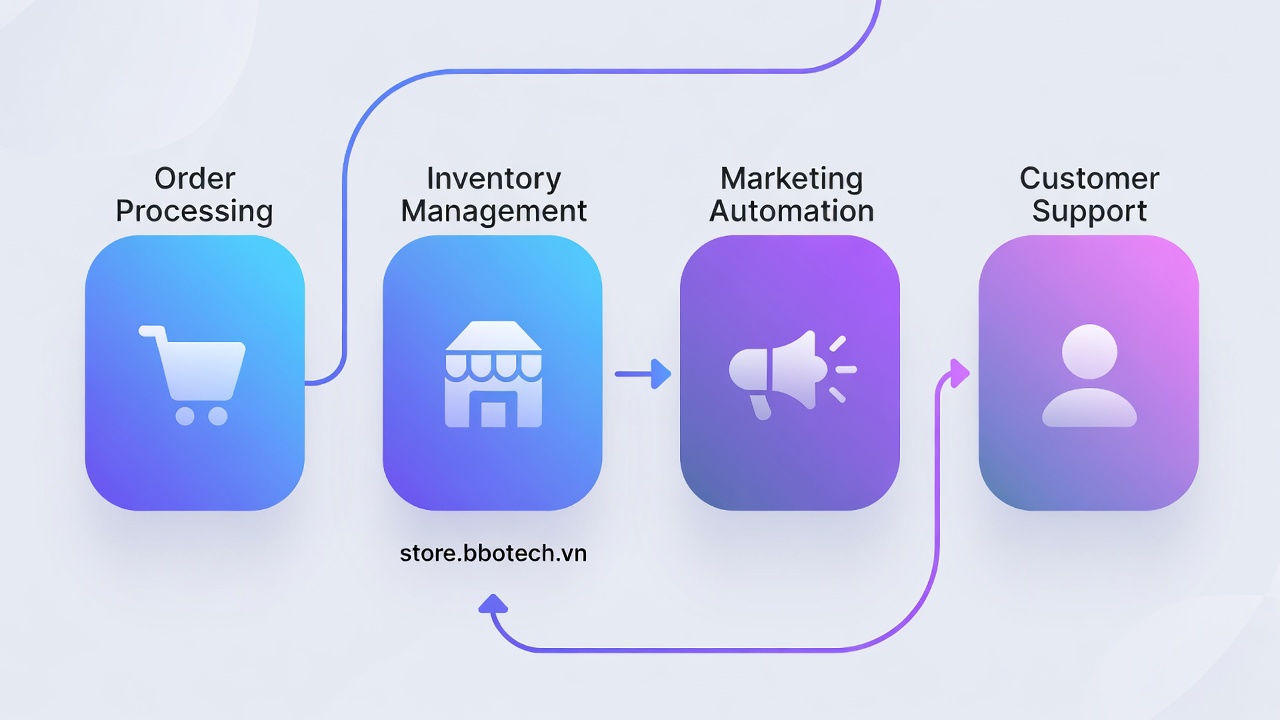
– AI agents that automatically optimize product pricing based on market conditions.
– Inventory demand forecasting with over 90% accuracy.
– Advanced chatbots that autonomously handle up to 95% of customer complaints and close sales.
Impact on Businesses and Employment
Opportunities: Increased efficiency, scalable growth without increasing headcount, and enhanced global competitiveness (especially for Vietnamese businesses selling online internationally).
Challenges: Job displacement in repetitive roles (WEF forecasts: 85 million jobs lost but 97 million new jobs created between 2025–2030). Businesses must invest in workforce reskilling and AI literacy.
Security & ethics: Higher data risks require choosing trustworthy technology partners.
Conclusion
The future of business automation is no longer about “whether to adopt” but “how to lead.” With agentic AI and hyperautomation rapidly approaching—especially from 2026 onward—Vietnamese businesses, from startups to online stores, have a unique opportunity to accelerate digital transformation in a sustainable way.
At bbotech.vn, we continuously update and deploy the latest technologies—from AI chatbots and workflow automation to customized agentic AI consulting for small businesses. We help you not only keep up with trends but truly stay ahead.
Are you ready to embrace the future of AI in business?
Contact us now via store.bbotech.vn or send us a message to receive a **free consultation** on the most advanced AI & automation solutions of 2026—complete with real demos and an implementation roadmap tailored to your budget.